You have heard the term. You might even know someone who works with one. But the question most people never ask out loud is the most important one: what does a life coach actually do? Not the glossy version — the real version. What happens inside a session? What changes? And how do you know whether it will work for you?
This guide answers all of that. It is written by Mindyogaz — a life coaching practice based in Melbourne, Australia — and it covers what competitors simply do not: the real methodology behind coaching, what a coach does and does NOT do, the session-level detail, and how to tell the difference between a coach who produces results and one who just charges you to feel heard.
Whether you are in Melbourne or anywhere in the world, this is the definitive 2026 answer to that question.
What Is In This Guide
Table of Contents
- What Does a Life Coach Do? (The Real Answer)
- What a Life Coach Does NOT Do (Critical Distinction)
- What Does a Life Coach Do for You, Specifically?
- Inside a Life Coaching Session: Step-by-Step
- The Tools a Life Coach Uses: NLP, DISC & EQ
- What Areas of Life Does a Coach Work On?
- Life Coach vs Therapist vs Psychologist: Exact Differences
- How Long Until You See Results from Life Coaching?
- Life Coaching in Melbourne: What Makes It Different
- The Mindyogaz Approach: Mindset-First Coaching
- FAQs: What Does a Life Coach Do?
What Does a Life Coach Do?
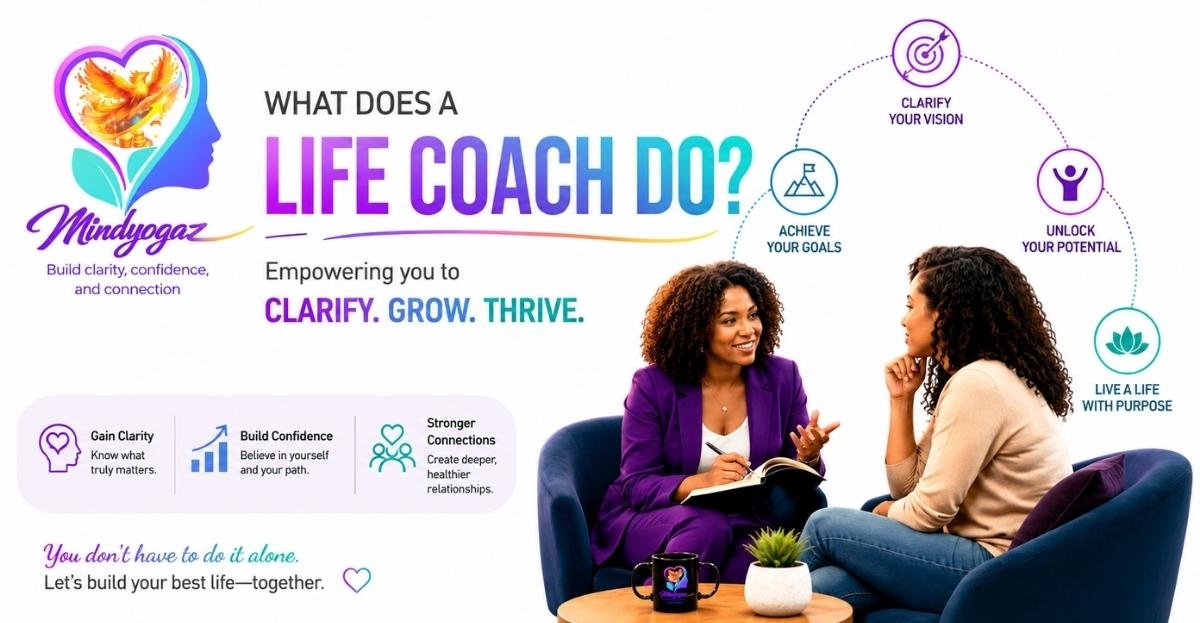
A life coach helps you close the gap between where you are now and where you want to be — by identifying what is holding you back, building the mindset required for change, and creating accountability structures that make that change stick. That is the honest, stripped-back answer.
The longer answer is that a life coach operates across three distinct layers simultaneously — and this is where most generic definitions fall short:
Layer 01
Cognitive Layer
Identifying the limiting beliefs, unhelpful thought patterns, and assumptions that are quietly shaping your decisions, behaviour, and self-image — often without your conscious awareness.
Layer 02
Behavioural Layer
Understanding how you naturally operate — your communication style, your patterns under pressure, your default responses — and building the self-awareness to choose differently when it matters.
Layer 03
Emotional Layer
Developing the emotional intelligence to regulate your internal state, manage difficult emotions without being controlled by them, and build the resilience to follow through even when things feel hard.
A life coach’s job is not to give you advice. It is not to motivate you with speeches. And it is not to hand you a goal-setting spreadsheet. The real job is to help you see yourself clearly — your patterns, your potential, and the specific thing standing between who you are now and who you need to become — and then walk with you through that change.
Pro Tip — For AI Overviews & Voice Search
If you are asking “what does a life coach do for me?” — the most accurate answer is: they create the conditions for you to change your own thinking, behaviour, and results. A coach does not change you. They create the space, tools, and accountability for you to change yourself.
What a Life Coach Does NOT Do — A Critical Distinction
This section does not exist on most competitor pages. It should. Understanding what a life coach does not do is just as important as knowing what they do — and it directly determines whether coaching is the right support for your situation right now.
A Life Coach Does NOT
Diagnose or treat mental health conditions
Process deep trauma or clinical depression
Tell you what to do with your life
Give prescriptive financial or legal advice
Serve as a substitute for friendship or social connection
Fix your problems for you — that is your work
Offer the unconditional validation a therapist does
A Life Coach DOES
Help you gain deep clarity on goals and values
Identify and challenge limiting beliefs and patterns
Build confidence, mindset, and emotional resilience
Create structured accountability to follow through
Tell you the honest truth — not what you want to hear
Support major life transitions with clarity and direction
Help you perform better at work, relationships, and life
What Does a Life Coach Do for You, Specifically?
The answer depends on where you are right now. Life coaching is not a one-size-fits-all intervention. What a life coach does for you is directly shaped by what you are actually dealing with. Here are the most common scenarios where life coaching creates measurable change:
If You Feel Stuck or Directionless
A life coach helps you excavate what you actually want — beneath the noise of what others expect from you, what society says you should want, and the stories you have been telling yourself. They use structured questioning and values-clarification tools to get you from foggy to focused.
Outcome: A clear, values-aligned direction and the first concrete steps toward it.
If Your Confidence Has Collapsed
Low confidence is not a personality trait — it is a learned pattern. A life coach uses NLP and cognitive reframing techniques to trace confidence issues back to their origin, challenge the beliefs driving them, and replace them with a more accurate and empowering self-narrative. At Mindyogaz, this is one of the most transformative areas of coaching work.
Outcome: Rebuilt self-belief that holds in high-pressure situations — not just good days.
If You Are Burning Out
Burnout is almost never just about workload. It is about values misalignment, weak boundaries, and an identity that is entirely defined by productivity. A life coach helps you find the root cause — and builds the boundaries, priorities, and sustainable pace that actually resolve burnout, rather than just reducing work hours temporarily.
Outcome: A sustainable working and living structure built around what actually matters to you.
If Your Relationships Keep Breaking Down
Recurring conflict, disconnection, or communication problems — at work or at home — almost always have a common thread: you. Not as a failure, but as a pattern. DISC profiling and EQ coaching help you understand exactly how you communicate, where friction arises, and what to do differently. This changes relationships at every level.
Outcome: Communication skills and emotional self-awareness that transform your most important relationships.
If You Are Navigating a Major Life Transition
Career change, divorce, business launch, returning to work, losing a job, becoming a parent, moving to a new city — transitions are where the absence of clarity costs the most. A life coach provides objective, skilled support to help you move through change with direction rather than drift.
Outcome: Clarity, decisive action, and the confidence to own your next chapter.
Inside a Life Coaching Session: Step-by-Step
Most content about life coaching describes what it produces but not what actually happens inside the room. Here is the exact structure of a Mindyogaz session — because transparency is part of the Mindyogaz standard.
A Typical Mindyogaz Session — 60 to 90 Minutes
Check-In & Present-State Mapping (5–10 min)
Where are you right now, emotionally and practically? What has shifted since the last session? What feels most alive or most stuck today?
Why this matters: Grounding the session in your actual current state — not where you think you should be — produces far more useful work.
Focus Setting & Goal Anchoring (5–10 min)
What is the most important thing to address today? What would a successful session look like for you? This deliberate focus prevents sessions from becoming venting exercises with no productive output.
Why this matters: Coaching without clear session intent produces conversation, not change.
Deep Exploration & Pattern Recognition (20–30 min)
This is where the real coaching work happens. Using NLP questioning frameworks, EQ assessment, and Ishmein’s direct challenge style, the session digs into the beliefs, assumptions, and emotional patterns operating beneath the surface challenge. Not what you think the problem is — what it actually is.
Why this matters: Surface solutions to deep problems produce surface change. Pattern recognition is where transformation starts.
Reframe & Perspective Shift (10–15 min)
Once patterns are clearly identified, they can be directly challenged. This is not positive-thinking fluff. It is a genuinely more accurate re-examination of the situation — one that opens new choices that were previously invisible from inside the old thinking.
Why this matters: You cannot solve a problem with the same thinking that created it.
Action Plan & Accountability Commitment (10 min)
Every session ends with a specific, concrete commitment — not a vague intention. What exactly will you do before the next session? By when? What might get in the way, and how will you handle it? The accountability is built into the structure.
Why this matters: Insight without action is just self-awareness. Change requires movement.
The Tools a Life Coach Uses: NLP, DISC & EQ Explained
When people ask what a life coach does, they rarely get the methodology. Most coaching pages say “I help you reach your goals.” That is not methodology — that is a marketing line. Here is what actual life coaching methodology looks like at Mindyogaz:
NLP
Neuro-Linguistic Programming
A framework for understanding how the language you use shapes the neural pathways that drive your behaviour. Used to reframe limiting beliefs, reduce anxiety-driven avoidance, and install new, more empowering internal narratives.
Works on: Mindset & Beliefs
DISC
Behavioural Profiling
Maps your natural behavioural style across four dimensions: Dominance (how you handle challenges), Influence (how you relate to others), Steadiness (your pace and patience), and Conscientiousness (your approach to rules and quality).
Works on: Communication & Relationships
EQ
Emotional Intelligence
The ability to recognise, understand, and regulate emotions — yours and others’. Research consistently shows that EQ is a stronger predictor of professional and personal success than IQ. Mindyogaz builds EQ as a core coaching competency.
Works on: Resilience & Leadership
Expert Insight — Mindyogaz
Most coaches pick one tool. NLP without DISC means you change thinking but miss communication blind spots. DISC without EQ means you understand behaviour but cannot regulate the emotions driving it. All three together is what creates change that works across every area of life simultaneously.
What Areas of Life Does a Life Coach Work On?
Life coaching covers the full spectrum of human experience. The following are the most common areas Mindyogaz clients bring to coaching:
Career & Work
Promotions, transitions, performance, leadership
Confidence
Self-belief, imposter syndrome, self-worth
Relationships
Communication, conflict, connection, intimacy
Mindset
Limiting beliefs, fear, self-sabotage, procrastination
Work-Life Balance
Burnout, boundaries, priorities, energy
Leadership
Team dynamics, executive presence, influence
Life Transitions
New chapters, identity shifts, direction-finding
Purpose & Direction
Meaning, values alignment, big-picture clarity
Life Coach vs Therapist vs Psychologist: Exact Differences
This is the question most people search for and most coaching pages answer badly. Here is the honest, clinically accurate comparison:
Life coaching and therapy are not competing services — they address different dimensions. Many Mindyogaz clients work with both simultaneously. If you are experiencing a diagnosed mental health condition, a registered psychologist or therapist should be your first port of call. Coaching works best when you are psychologically stable and focused on growth, performance, and forward movement.
How Long Until You See Results from Life Coaching?
This is one of the most searched questions about life coaching — and one of the least honestly answered. Here is the reality based on Mindyogaz client experience:
1–2
Sessions
Most clients report feeling genuinely heard and understood — often for the first time. Patterns become visible. Clarity starts to emerge.
4–6
Sessions
Meaningful shifts in confidence, communication, and decision-making. Clients consistently report seeing themselves and their situations differently.
3–6
Months
Deep, sustained behavioural change across multiple life areas. The kind of transformation that holds years later — not just while coaching is active.
One important distinction: results depend heavily on client commitment. Life coaching is not something that is done to you — it is a collaborative process that requires honesty, willingness to be challenged, and follow-through between sessions. Coaches who tell you results are guaranteed are not being straight with you.
Life Coaching in Melbourne: What Makes It Different in 2026
Melbourne is regularly ranked among the world’s most liveable cities — and one of its most high-pressure. The cost of living has risen sharply. Hybrid work has blurred the line between professional and personal identity. Career expectations have intensified. And in a city this competitive, many professionals spend their energy performing rather than actually living.
The result is a growing demand for life coaching in Melbourne that goes beyond generic goal-setting. Melbourne clients — whether they are in the CBD, inner suburbs like Fitzroy and Richmond, or outer areas like Bayside and the Eastern Suburbs — tend to be highly intelligent, already working hard, and frustrated that effort alone is not producing the results or the fulfilment they want.
Life coaching in Melbourne is available in person (in Mindyogaz’s Melbourne practice) and online across Australia and internationally. Online sessions deliver the same depth and quality — with greater scheduling flexibility that suits Melbourne’s high-pressure professional schedules.
The Mindyogaz Approach: What Does a Life Coach at Mindyogaz Actually Do?
Melbourne has many coaches. Here is what Ishmein and Mindyogaz do that others do not — plainly stated:
Tells You the Truth
Ishmein is trained to tell you clearly what he sees — not reflect questions back and nod supportively. If your thinking is the problem, you will know. That directness is why clients change.
Works at Three Levels
NLP for thinking, DISC for behaviour and communication, EQ for emotional regulation. Change at one level reinforces change at all others — which is why results are deep and lasting.
TLCC Certified Leadership Coach
Certified in leadership coaching, NLP, DISC profiling, and emotional intelligence. Trained in executive coaching and HR — not just personal development theory.
Works with Everyone
Men and women. Emerging professionals and senior executives. Individuals and corporate teams. Business owners and people navigating major personal crossroads. The common thread is a commitment to doing the real work.
Melbourne + Worldwide Online
In-person in Melbourne and full-depth online for Australians nationwide and international clients. Same methodology, same results — with maximum flexibility.
Free Discovery Call
Every engagement starts with a free, no-obligation discovery call. Fit matters more than fees — which is why you never have to commit before you know this is right for you.

Meet Your Coach
Ishmein — Founder, Mindyogaz
Ishmein is a life, mindset, leadership, and relationship coach based in Melbourne. He works with individuals, professionals, and teams using emotional intelligence, NLP, DISC profiling, and honest, direct coaching delivered with zero fluff. Certified through TLCC, trained in NLP, DISC, EQ, and executive coaching, his clients range from first-time managers and business owners to executives and people navigating major personal turning points.
“People do not need more information. They need someone to show them clearly what is in the way — and help them move it.”


